Monday, November 5, 2012


Overall this section proved to overall be a disappointment to me. I was first upset with how the author got rid of Ms. Wilcox’s character by having her going to Paris. She was the perfect role model for Mattie; a successful, assertive, independent woman and writer. However by leaving her running away from her husband and her problems I feel it began the spiral of uncertainty in Mattie’s life.

When I found out her decision to stay and be with Royal I became even more frustrated. I was outraged when I read “I’m not going. I’m not going to New York City… Royal and I… we’re sparking. I’m going to… he’s… I’m staying here. We’re going to be married.” (312). In just these few lines she made it apparent that she was completely letting go of her dreams. I think this realization can easily be tied to her teacher also letting a man have complete control of her life. I found myself angry that she was staying in Northern Woods to live the life that she most definitely does not want. However, as I kept reading it turns out that Royal was merely using Mattie to get a portion of her father’s land. Finding out the truth about the deceiving Royal Loomis and his intentions was shocking. My heart broke for Mattie but I was happy with her final decision to go to New York.

To wrap it up I found myself to be dissatisfied reading the last section of this book. I thoroughly enjoyed reading the other sections of this book and was extremely intrigued by the characters, setting, story, and the writing style. However the ending seems to be lacking the conclusion I feel the story rightfully deserves. Reading the last few pages it seemed almost thrown together which was very unlike the rest of the story. I find myself unsettled with how she left off Grace Brown’s murder and Mattie’s decision to go into the City. I will never know exactly what happened to Grace, who Chester/ Carl was and if he killed her,and also if he will get the punishment that he deserves. Matties future is all up to speculation too; whether she made it to Barnard or not and how that turned out. Also what happened to Ms. Wilcox, Weaver, her family, and the rest of the characters from North Woods. The story leaves me with many unanswered questions but I am left to assume that everythting turned out the way it was went to for Mattie. I can only hope that all of her dreams came trye and she moved on to live a happy successful life.

Sunday, November 4, 2012

Blog 4: Pgs. 296-381

     After reading the fourth and final section of A Northern Light by Jennifer Donnelly, I cannot help but be a little disappointed.  I was really hoping that Mattie would do something more with the lettters that reveal so much about a tragic event.  In the end she just leaves the letters on her bosse desk and does nothing more with them.  This just bothers me because I wish that Mattie would have told somebody what she knows about the murder instead of simply just letting it go.  She seems irresponsible to me.  She even says, "No one will ever find out that Grace was pregnant or that Chester Gillette was the father of her child.  Her death will be Carl Graham's fault, and Chester will be free to return to Cortland and have a good and dandy time," (379).  She knows that what she does will allow a man to get away with murder, but swhe does it anyway.  I cannot bring myself to like the way that the author handled this part of the story.  I wish it had ended a little differently.  That being said, I couldn't help but feel joy when Mattie finally was able to go to Barnard.  With Mattie's last words of the book, she says, "To Amsterdam and Albany and beyond.  To New York City.  To my future.  My life," (380).  Finally, Mattie gets what she wants.  A shot at her dreams is all she wanted the entire novel and she finally got it.  I thought that in this aspect of the book, the Author ended it perfectly.  It was simple, yet it was powerful in sending a message on not giving up on something you truly believe in and want for yourself.  Despite the odds, Mattie has prevailed and as a reader you cannot feel happier for her.
     Also, it has been mentioned time after time after time, but I cannot seem to get over how different the times are now than they were in 1906 when this novel takes place.  We get yet another example of how just the prices of things were so dramatically different than they are now when Mattie gives Weaver seven dollars.  "What's this for?" Weaver asks, "For your train ticket to New York," (375).  Call the papers!  People are getting great deals on train tickets!  If we saw these prices for train tickets nowadays we'd think it was a huge bargain,  but then we remember that seven dollars was a lot of money for them back then and it's something that we are astonished by.
 
For more info on why prices have changed so dramatically, check out                                             http://www.economist.com/node/457272

Pages 296-380 Reflection


     We have finally reached the end of the book. Though the ending wasn’t necessarily up to par with the rest of the book, I would say it was still a very good book. Just as I had hoped, the author delivered several more thought-provoking statements that I really caught hold of. One was when Mattie was talking about one of her calves. Daisy, one of their best cows, had died recently and one of her babies was struggling with the loss. Mattie says, “…he wanted Daisy. But he couldn’t have Daisy, so he finally took what was offered. Like we all do” (299). By talking about this scenario even with a cow, Mattie has hit upon one of the sad truths of life. Humans are settlers. Not settlers like they settle land, but settlers in the way of giving up because something “isn’t worth the effort.” Now in the cow’s case, obviously fighting harder isn’t going to bring its mother back. However, most often when people settle for less they are doing so because they don’t feel like fighting for it. Mattie’s tone when she thinks about this points to the idea that she is saddened by this fact. She knows that certain things just aren’t worth arguing, like the loss of a loved one but something like our soccer team playing in the play-offs is definitely worth fighting for. Say we settled for winning one play-off game and decided we weren’t going to try too hard tonight. We would have driven an hour and a half and played half-heartedly and most likely lost. Instead, we weren’t satisfied and we played our hardest and won. We are in the quarterfinals for it. Some things are just worth fighting for.
     The next topic I picked up on was a sad but subtle one. When Mattie’s friend Weaver is thinking about not going to college Mattie says “‘Just go! Before you’re stuck here forever. Like an ant in pitch.’ Like me” (358). I say this is sad because it seems like Mattie has given up hope. I’ve talked a lot about the potency of hope, both good and bad, in my previous posts. It’s upsetting to me that after everything she’s gone through she has nearly accepted the fact that she isn’t going to escape her farm life. The author does a fantastic job of making the reader feel sympathetic to Mattie and her current situation.
     And lastly, there was one more of those thought provoking quotes that I thought I should discuss. Even after Mattie reads all the letters from Grace Brown, She still doesn’t want to burn them. She is worried that Grace’s voice will never be heard again. She goes on to elaborate about what she has come to understand about the concept of voice: “Voice, according to Miss Wilcox, is not just the sound that comes from your throat but the feeling that comes from your words” (361). Though this quote comes relatively late in the text, is emphasizes a theme that has been obvious throughout the entire text. This is that words are powerful tools that can do good or harm, so they must be chosen with the utmost of care. Mattie’s obsession with words has taught her this but I believe a lot of time this lesson can be forgotten. In the end this book contains a lot of valuable lessons like this one and I think it is certainly worth your time.

Pages 296-380 Reflection

     This last section of the book was a banger filled with some surprises, and some victories.  Some of the surprises that came with this ending section of the book were near the beginning of this reading.  After having a week off of work, Mattie has to go back and she is spending her last day with Miss Wilcox and Royal Loomis, and before leaving "Well, here then,' Royal suddenly said.  He held out a small square of tissue paper. It was folded over several times. There was something inside of it. I opened it and saw a dull gold ring" (298).  So Royal asks to marry her. This is a surprise, but also it could be seen that it was going to happen soon.  With the past incidents between the two of them in the book, things were heating up and Royal finally asked her. Mattie said yes to Royals request, and knew that this would kill her chances of going to Barnard.  However this was not the only surprise that occurred in this section of the reading.  I felt that this was even more surprising was that Miss Wilcox was leaving.  A package had been sent to Mattie, but was unable to get to her when Miss Wilcox had sent it herself, in this package she also got several books and five dollars from her great teacher. "As I wish to leave you something by which to remember me. I am departing Eagle Bay tomorrow. I won't be teaching next year. I had hoped to tell you this in person, but Mrs. Morrison was unable to locate you" (305).  This is the big shocker of the section, and Mattie is heartbroken so she leaves to go and speak with her in person back near home.  Mattie proceeds to go to Miss Wilcox's house and finds out that she must leave or her husband with come get her, and although really not wanting her to leave Mattie accepts what is happening.  I feel that the reason why she wants her to stay is because she is thinking that she is going to stay in her hometown when marrying Royal, because if she was going to Barnard then she would leave her anyway, but since she plans to stay she has to tell Miss Wilcox why she is so sad that she is leaving.  Mattie even tells her teacher leaves her feeling good a brave about herself and she does not want her to leave because she will feel powerless.
     Finally for what I would say is the victory of this final section, is that Mattie Gokey finally decides that she wants to go to college!  After a long time of hard work, thinking, and discoveries, Mattie finally decides that she wants to go to Barnard. But its not a way that everyone knows where she is, she leaves early on in the morning and only tells one person, and that is Weaver. Weaver asks Mattie why he is going, and she replies "Because Grace Brown can't " (376). Because Grace Brown can no longer fulfill what she wants to do, Mattie says its for her.  I think it is because it has been what she always wanted to do, and she snow going to be able to do it.  So as she finally goes to the dream college that she was dreaming of, she abandons the life that she had as a farm girl, and gets ready for her future, and her new life.
     I really liked how this book finished up, and I am glad that she finally got to do the things that she wanted to do, making all the hard work she put in worth something.


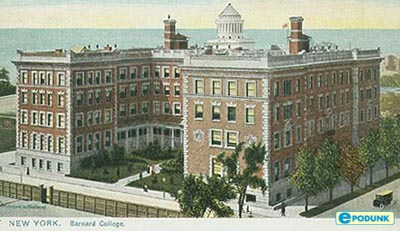
Hyperlink: Barnard College: http://www.nyc-architecture.com/HAR/ny_col_barnard01.jpg